


The Thesis
The structural default.
A performing asset does not become distressed because the market changed its mind. It is executed into distress, then financed into brownness. Both are design flaws. Both are removable.
The refinancing wall
Eight trillion dollars has to be refinanced.
Commercial real estate is entering the largest refinancing cycle in its history: an estimated $8 trillion of global debt maturing this decade. The assets behind it are not uniformly bad. Many are sound buildings with sound tenants and a loan that no longer fits.
The wall is usually described as a rate problem. It is not. Rates set the price of the refinancing. Execution decides whether there is anything worth refinancing.
Why refinancing fails
A lender declining is judging the next ten years.
Three physical facts drive that judgment, and all three are produced long before the loan matures.
-
Late decay discovery
The defect surfaces after the warranty, after the contractor, and after the moment when a planned retrofit would have been cheap. What remains is a capital call, a discount, or a sale into a market that has already repriced the asset.
-
CapEx variance
The build costs more and takes longer than the model. The difference is carry interest, drawn against a facility that assumed a schedule. By stabilisation, the asset is carrying a cost base it cannot service at the rent it can achieve.
-
Opacity
The lender cannot see the structure, the systems, the maintenance history or the residual life. Without evidence, the asset is priced as the sector average — and the sector average is being repriced downward.
The brown discount
"Brown" is a pricing category, not a moral one.
An asset that cannot document its energy performance, its structural condition or its maintenance path is priced as though it will fail those tests — because the buyer has no reason to assume otherwise.
Regulation accelerates the repricing. Energy-performance standards and carbon penalties turn an information gap into a cash cost. The asset does not become brown when the penalty arrives; it becomes brown when the evidence stops.

What must exist instead
If the problem is produced at three points, the solution has to exist at all three.
-
A standard for the whole life of the asset
Not just its delivery. Decay is scheduled, retrofit is priced at origination, and evidence is a requirement rather than a courtesy.
-
An execution process that holds variance
Because carry is a function of time, and time is a function of coordination.
-
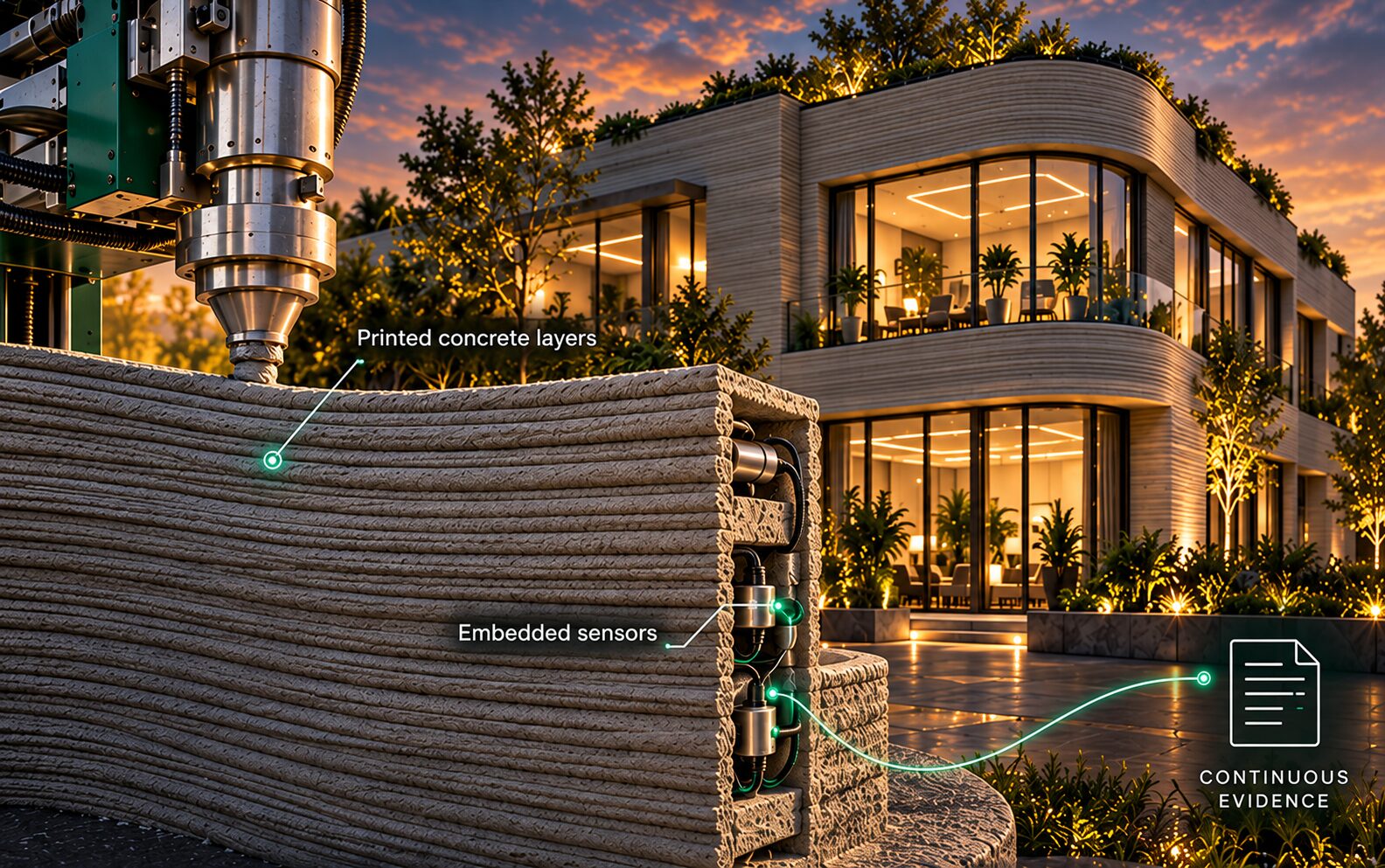
A trust layer that turns both into data a market can price
Regulator-compliant, rating-agency-readable, continuous.
Remove any one and the chain fails. A standard without execution is a specification nobody follows. Execution without a record is a good build that nobody can underwrite. A record without either is a dashboard describing a decayed asset.
What it changes
The asset re-enters the capital markets as evidence.
- For the asset: obsolescence becomes a managed schedule instead of a discovery.
- For the developer: carry stops being the price of coordination failure.
- For the fund: loss given default becomes an engineering input.
- For the bond buyer: the security is priced on evidence, not on a sector narrative.
- For the insurer: the risk is a measured structure, not a surveyor's opinion.
The incumbent model surveils cash flows monthly. This one surveils the collateral continuously. That is the difference between repricing a sector and pricing an asset.
What we are building
The evidence layer real estate has never had.
Parametric Assets, financed through Credit Pools, delivered to qualified institutional buyers as security bonds. Stress-test the thesis — bring the objection you think breaks it.
Talk to the research desk